L1_Lesson7_Understanding Neural Networks
Purpose: Students will construct a neural network that makes decisions based on inputs.
Vocabulary: Input & Training Data (Embeddings), Neural Network (Input Nodes, Weights, Hidden Layers), ,
Review: I will post the AI vocabulary terms we have learned to date and the students need to 1.Define them, 2. Explain how each allows AI to Fx.
Large Language Models, Training Data, Prompts, Tokens, Embeddings, Neural Networks, Hidden Layers, Weights, Nodes.
Activity #1: The Need For Neural Networks
- Ask students to fill in a word in the following sentences:
- "The _ _ _ _ was dancing in the rain."
- "Dancing was _ _ _ _ in the rain."
- Notice how similar the sentences are. A.I. may break down Text into Embeddings, but sentences aren't Random...Languages have Grammatical Rules.
- "Large Language Models" need "Neural Networks" to establish the "Relationship" between Text.
Activity #2a: Help A.I. Develop Cafeteria Menu
Student Survey:
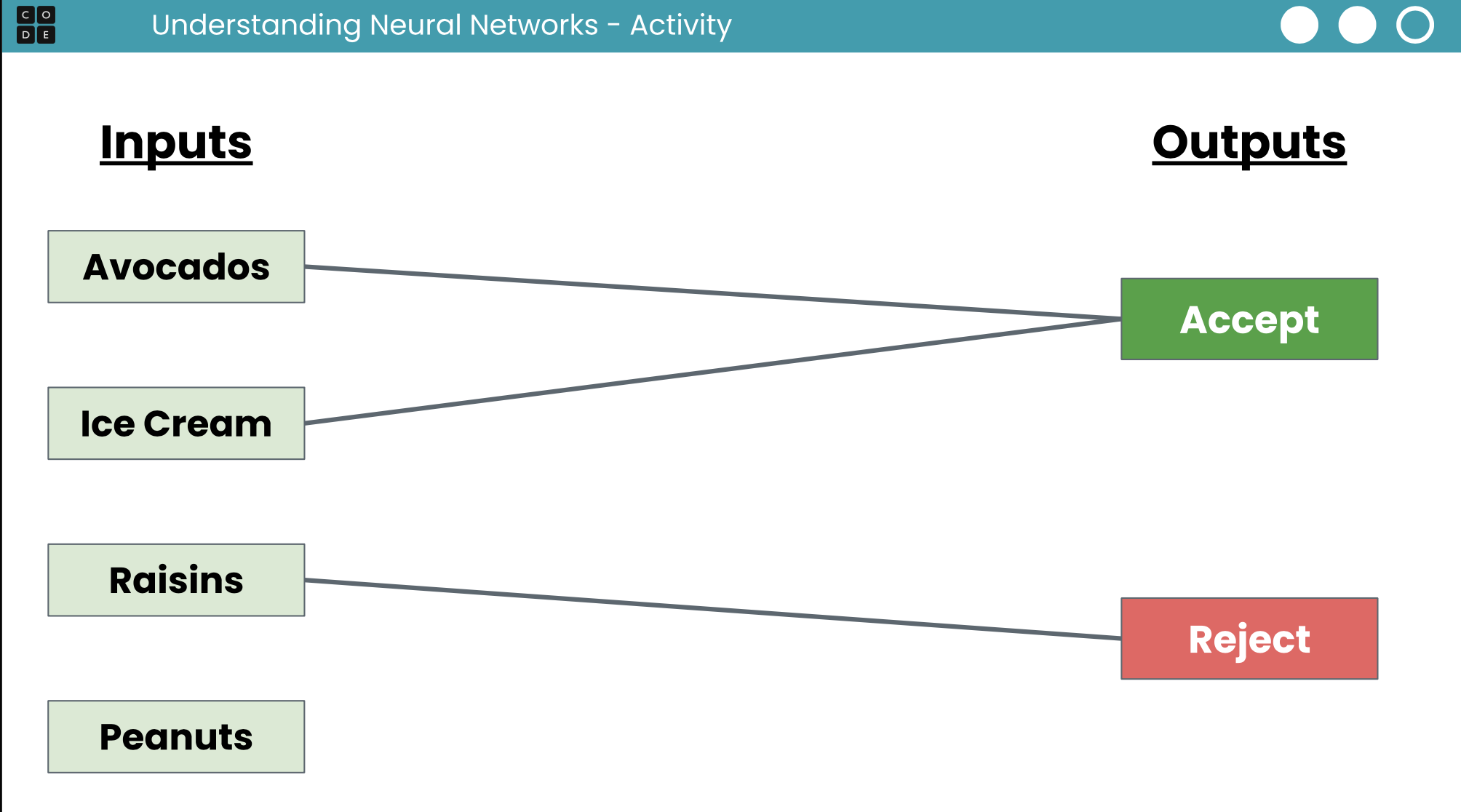
- Avocados +
- Ice Cream +
- Raisins -
- Peanuts ?
|
|
We enter the Data into a "Neural Network".
There are 3 parts that make up a "Neural Network", Input / Hidden Layer / Output. |
This is what the outcome should look like:
|
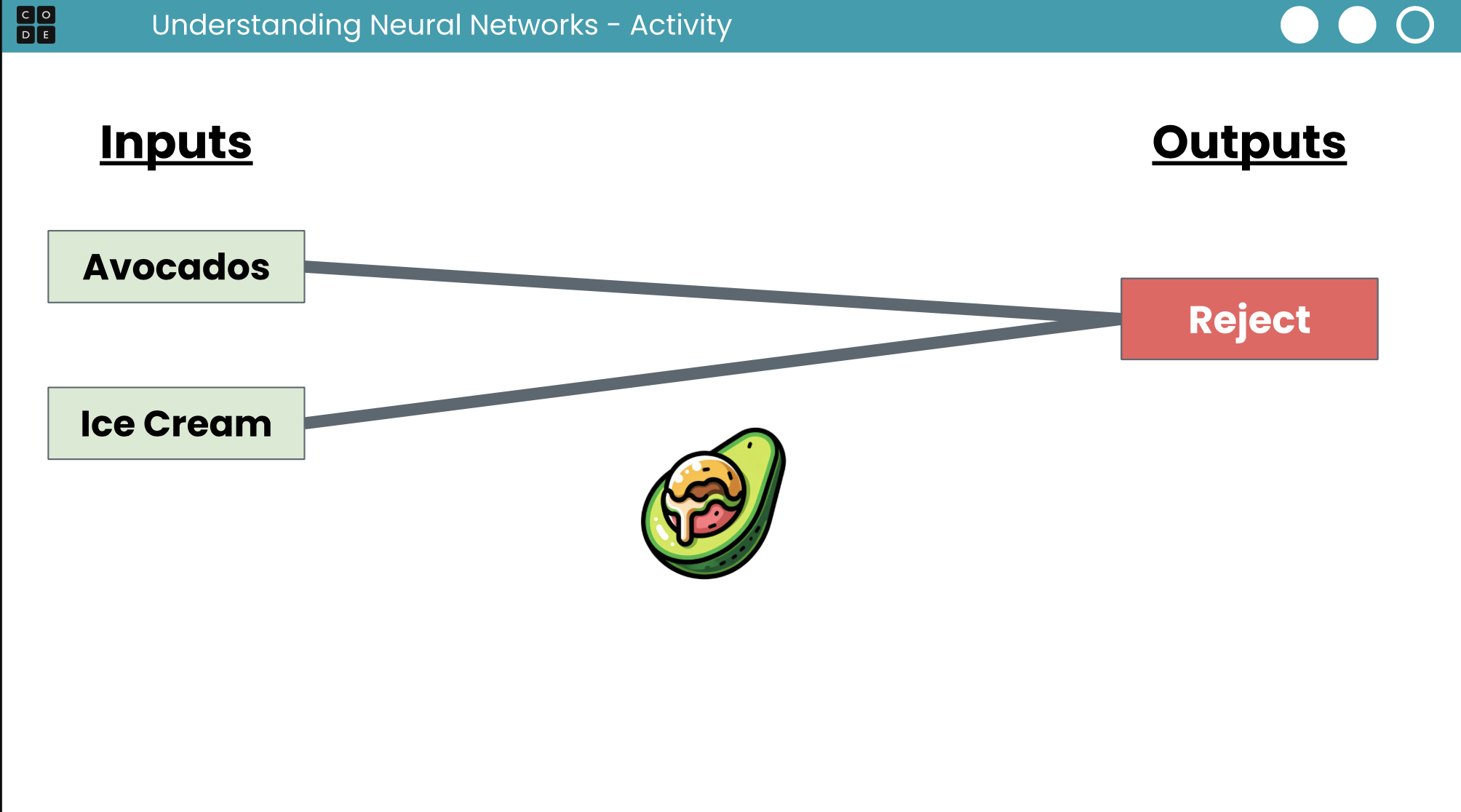
Present findings to "Neural Network"
- But instead, it got Rejected.
- What happened? How did it get "Rejected"?
- The Neural Network interpreted it as Ice Cream on Avocado, and nobody wants that..."Reject."
|
 |
The Hidden Layer, Weights and Nodes:
Lets help AI make better decisions by giving it extra information increasing its ability to more clearly see the relationships between the data (in this case "Text".) coming in from the "Inputs". |
The Hidden Layer is the area between the Inputs and the Outputs. Think of the "Hidden Layer" is like a Human Brain where Extra Information is added over many layers to help AI better understand Relationships between the Data (text).
Nodes (the black circles) help AI better understand the Relationship of the Data entering from the "Inputs" so that it will hopefully lead to a better "Output." |
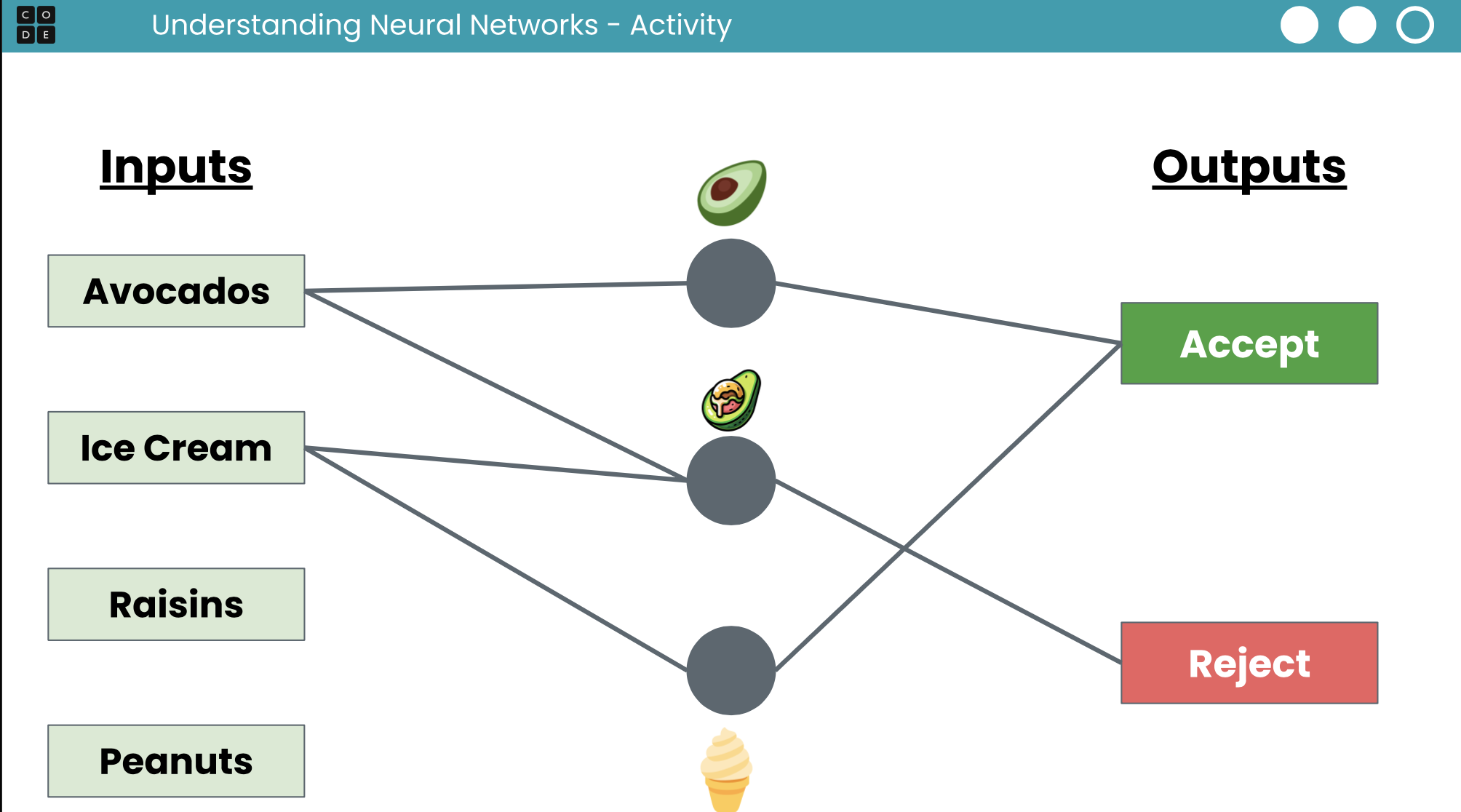 |
But this image shows that two different decisions are being made from the same "Inputs" |
| Weights help solve the problem of having multiple decisions. In this case, a lower weight is considered better than a higher weight, so the 'just avocado' and 'just ice cream' are given a lower score and a higher weight to the 'both' connection. |
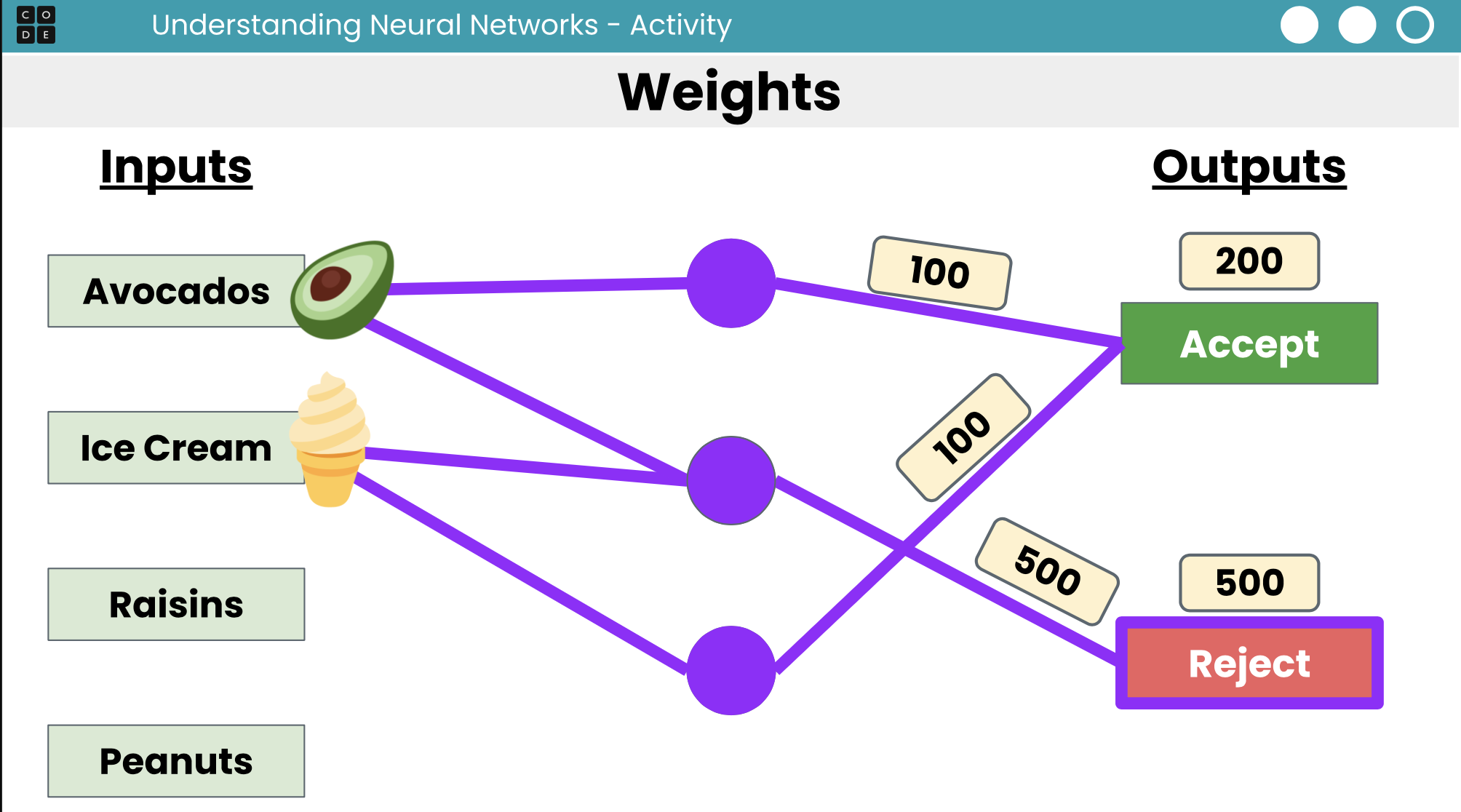 |
| Summary: Neural Networks rely on Weights to make decisions. |
Activity 2b: Students should now create their own scenario based upon the scenario being modeled above. It should include:
- What is the scenario?
- Survey results.
- Draw an image where the Neural Network could either Accept or Reject and explain why.
- Draw a Neural Network image that shows Inputs / Hidden Layers / Ouputs / Nodes / Weights.
Video: Generative AI: Storage & Embeddings: https://www.youtube.com/watch?v=s1fhxAVpYx8 (I recommend watching this video twice!).